GIS Analyst — Agricultural Research
3.5–8 LPA
Hiring: ICAR institutes, ISRO-NRSC, KSRSAC, state remote sensing centres, soil survey departments
The single most career-defining skill a B.Sc. Agriculture graduate can add to their CV in 2026.
Master QGIS, satellite imagery, NDVI, and spatial analysis — the exact tools ICAR, ISRO-NRSC, agritech startups, and precision agriculture companies are actively hiring for. Taught by a working GIS Specialist at KFRI Thrissur. Certificate issued only after you complete a real practical project.
Or get the full syllabus on WhatsApp →
Taught by Kavya Prabhakar · GIS Specialist & GIS-RS Workshop Instructor, KFRI Thrissur
Incubated Under
Transforming Rural Future · A KAU - NABARD - WSU initiative
GIS for Agriculture is incubated under K-AgTech Launchpad, a joint initiative of Kerala Agricultural University, NABARD, and Western Sydney University - backing courses that turn agriculture graduates into industry-ready professionals.
Career-first reasons
B.Sc. Agriculture gives you strong domain knowledge in crops, soils, and extension. But it rarely teaches the digital and spatial tools that modern employers - government and private - increasingly expect. This course closes that gap, directly.
Government research institutes, state remote sensing centres, and soil survey departments need GIS-literate agriculture graduates. Most applicants don't have these skills - you will.
Precision agriculture firms, drone-monitoring companies, crop-insurance analytics, and digital farming startups (DeHaat, CropIn, AgNext, John Deere India) hire B.Sc. Agriculture graduates with QGIS skills at significantly higher salaries than peers.
Remote sensing and GIS topics now appear regularly in ARS-NET, ICAR-JRF, and M.Sc. entrance papers. Conceptual + hands-on knowledge gives you a measurable advantage.
FPOs, panchayats, and small agribusinesses increasingly need farm mapping, land suitability assessment, and crop monitoring services. With QGIS skills, you can take on paid projects while still studying.
Agri Stack, India's Digital Agriculture Mission, and climate-smart agriculture are reshaping the sector. Spatial literacy is becoming a baseline expectation - not optional - for the next generation of agri-professionals.
Sample lessons
Two short lessons from the actual course. No signup required.
Sample Lesson 1 — Course Introduction
Sample Lesson 2 — GIS in Action
These are sample previews. The full course includes 50+ hours of structured video lessons with downloadable practice files.
Who this is for
Add a CV-distinguishing technical skill before placement season. Stand out in interviews where every other candidate has the same syllabus.
Bridge the structural skill gap between what your degree taught and what employers - government, agritech, and research - actually want.
Build conceptual + practical knowledge of GIS and remote sensing topics that increasingly appear in competitive papers.
Add a high-value skill that makes you indispensable in projects, reports, and field-level planning.
What you’ll be able to do
Open-source toolchain
All free and open-source. No software licence costs — ever.
Curriculum
8 modules of structured instruction + a final project week. Theory builds the foundation; practicals build the skills; the capstone builds your portfolio.
Download the complete syllabus PDF — 3 pages, every topic listed.
Career outcomes
Roles that actively value GIS and remote sensing skills — across government, research, and the fast-growing agritech sector.
3.5–8 LPA
Hiring: ICAR institutes, ISRO-NRSC, KSRSAC, state remote sensing centres, soil survey departments
6–15 LPA
Hiring: DeHaat, CropIn, AgNext, John Deere India, Mahindra Agri
8–18 LPA
Hiring: ISRO, IIRS Dehradun, NRSC, private geospatial consultancies
4–10 LPA
Hiring: NABARD-funded projects, KILA, World Bank agriculture projects, FAO, environmental NGOs
5–12 LPA
Hiring: Drone service providers, crop-insurance analytics firms, agri-fintech startups
3–6 LPA + stipend
Hiring: ICRISAT, KFRI, agricultural universities, ICAR-AICRP projects
15k–60k per project
Hiring: FPOs, cooperatives, panchayats, small agribusinesses needing farm mapping and land suitability work
Salary ranges are industry estimates as of early 2026 and vary by role, location, and experience. The course does not guarantee employment — it gives you a credible, demonstrable skill that improves your candidacy.
Portfolio outcomes
Most online courses end with a quiz. This one ends with two real projects you can put on your CV and walk a recruiter through.
PROJECT 1 · KERALA CASE STUDY
Apply everything you've learned - satellite data download, NDWI analysis, raster processing, vector digitization - to identify and extract wetlands in an ecologically important Kerala region. Output: a complete analysis report and map layout.
PROJECT 2 · INTERNATIONAL CASE STUDY
Use NDVI and NDWI on real Sentinel-2 satellite imagery to assess crop health on a European vineyard. Produce a full agricultural land health analysis report - the same type of deliverable used in precision agriculture consulting.
Project-gated certificate — issued only after Kavya reviews and approves your submitted work.
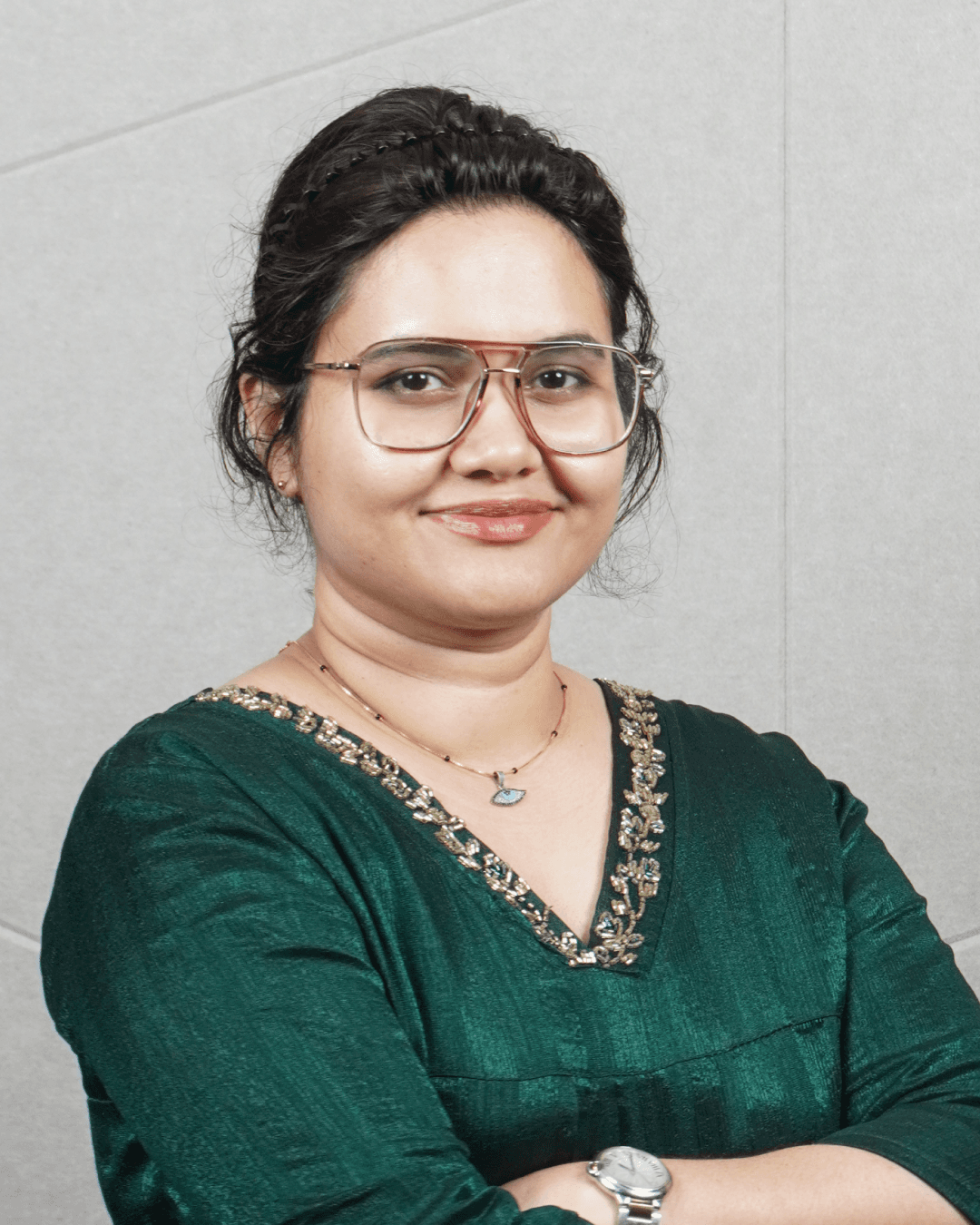
Kavya Prabhakar
GIS Specialist & GIS-RS Workshop Instructor, KFRI Thrissur
Meet your instructor
GIS Specialist & GIS-RS Workshop Instructor, KFRI Thrissur
Kavya Prabhakar is a practising GIS Specialist at the Kerala Forest Research Institute (KFRI), Thrissur, where she works on real research projects involving spatial analysis, remote sensing, and environmental monitoring. She also runs GIS-RS workshops, which gives her years of experience translating complex spatial concepts into hands-on, learnable steps. Every module in this course reflects techniques she uses in her professional work - not textbook theory.
What makes this different
Most GIS courses online are in English, which slows down conceptual learning for many Kerala students. Kavya teaches the entire course in Malayalam - concepts land faster, doubts get cleared deeper, and you still become fluent in the English-language software interface every employer uses.
Every module is framed for agricultural applications - crop health, soil, water resources, land use. Not a generic GIS course with agri examples bolted on.
Taught by a working GIS Specialist at KFRI Thrissur - backed by real research and training experience.
Your certificate is issued ONLY after a practical assignment is reviewed and approved by the instructor. Recruiters know the difference between a participation badge and proof of skill.
Built entirely around QGIS and free data portals. No software licence costs ever - you can keep working with these tools your whole career.
Kerala case study (Thrissur-Ponnani wetlands) plus international scenario (European vineyard) - regional grounding plus global applicability.
On-demand video access. Designed for working graduates, exam aspirants, and final-year students who can't commit to fixed live schedules.
Every module, every topic. Drop your number and we’ll send the full module-by-module syllabus straight to your WhatsApp - no spam, just the curriculum.
FAQs
Included with enrollment
Stuck on a QGIS workflow? Confused about an NDVI result? Ask your doubt anytime — a single continuous chat thread with your instructor. Mon–Sat, replies within 24 hours.
Sign in with your email — no password
Join the first batch. Self-paced — start today, finish at your pace.
7-day money-back if it’s not a fit · Mon–Sat, 9 AM – 5 PM IST